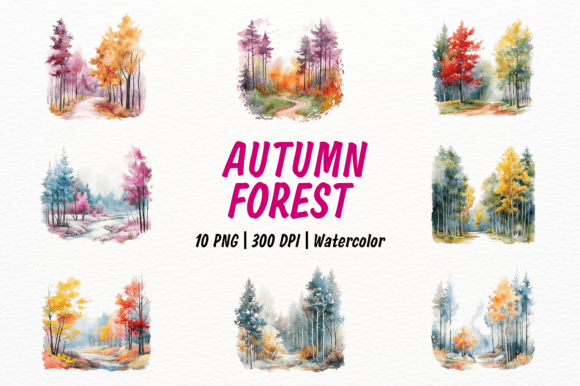
Autumn Forest Watercolor Collection
There is something quietly compelling about a typeface that does not try to shout. The Autumn Forest Watercolor Collection belongs to that rare category of design assets that feel both intentional and organic—as if the letters were not so much drawn as they were grown. The collection draws its character from the warm, shifting palette of late-season woodlands: burnt orange, russet brown, deep amber, and the faint green of moss clinging to bark. Each glyph carries a hand-painted texture, with uneven edges and subtle watercolor blooms that give the letterforms a living, breathing quality. This is not a font that sits flat on the page. It has depth, movement, and a quiet confidence that works well when you want your message to feel personal rather than polished.
The visual personality of the collection is warm, nostalgic, and slightly rustic without tipping into overly decorative territory. It strikes a balance between expressiveness and legibility—something many hand-painted typefaces struggle to achieve. The strokes feel natural, as if painted with a real brush on textured paper, and the spacing is generous enough to allow each letter to breathe. Whether you are working with a single word or a short headline, the collection brings a tactile, human quality to the screen or page. It is the kind of typeface that makes people want to reach out and touch it.
A Typeface That Captures the Season's Palette
The visual appeal of the Autumn Forest Watercolor Collection lies in its restraint. Yes, the colors evoke autumn, but the collection does not rely on clichés like falling leaves or harvest motifs. Instead, the warmth comes from the texture and the subtle gradations within each stroke. Some letters show darker pooling at the edges, mimicking how watercolor pigments settle as they dry. Others have softer, more diffuse fills that suggest diluted washes. These details are not random—they are carefully calibrated to create a consistent mood across the entire character set. For designers and content creators, this means you can use the font in projects where you want to evoke a sense of coziness, authenticity, or handmade care without overpowering the rest of your layout.
The overall style is best described as contemporary rustic. It does not look like a vintage reproduction, nor does it try to imitate a specific historical period. Instead, it feels current but grounded—a typeface that could appear on a craft coffee bag, a wedding invitation, a seasonal marketing email, or a set of social media graphics promoting a fall product launch. The handwritten quality is present but not exaggerated, making it suitable for audiences who appreciate design that feels deliberate and unpretentious.
Where This Collection Shines in Real Projects
If you are a brand strategist or small business owner looking to differentiate your visual identity, the Autumn Forest Watercolor Collection offers a clear path. It works especially well in logo design for brands that want to communicate warmth, craftsmanship, or a connection to nature. A wordmark set in this typeface immediately signals that the brand values texture and authenticity over sleek perfection. For packaging design, particularly for products like artisanal food, skincare, candles, or stationery, the collection adds a handcrafted feel that can elevate shelf presence without requiring elaborate illustration.
In editorial design, the typeface serves as a strong display option for pull quotes, chapter openers, or section titles in magazines, lookbooks, or journals that focus on lifestyle, travel, or creativity. It pairs naturally with clean serif fonts or understated sans serif fonts for body text, creating a contrast that guides the reader's eye without creating visual noise. For web design, the collection can be used in hero headings, landing page titles, or call-to-action blocks where you want to break away from standard templates and inject personality. Just be mindful of loading times—use the font sparingly as a display accent rather than for long paragraphs, especially on mobile.
Beyond professional work, the collection is a natural fit for social media graphics. Think Instagram posts announcing a new product, Pinterest pins for seasonal content, or YouTube thumbnail text that needs to stand out with a handcrafted feel. Content creators and bloggers will find it particularly useful for rebranding or refreshing their visual identity with minimal effort. The collection also works well in print projects like greeting cards, art prints, and event signage, where the watercolor texture can be fully appreciated at larger sizes.
How It Shapes Brand Perception and Audience Connection
Typography does more than carry words—it sets a tone before a single letter is read. The Autumn Forest Watercolor Collection influences brand perception by introducing an immediate sense of warmth and human touch. In a landscape where so much design relies on clean vectors and sterile perfection, a typeface with visible brush strokes and pigment variation feels refreshingly honest. It tells the audience that someone cared enough to make something by hand, even if it is delivered digitally. This can be a powerful tool for brand identity work, especially for companies positioning themselves as sustainable, artisanal, or community-focused.
From a visual hierarchy perspective, the collection functions best as a hero element. Its texture and color variation draw the eye naturally, making it ideal for headlines, titles, and key messages that need to anchor the page. When used thoughtfully, it improves readability by providing clear contrast against simpler background elements. The key is to give it space. Crowding the typeface with competing textures or busy imagery will dilute its impact. Let it stand alone or pair it with minimal design elements. The result is a layout that feels curated, not cluttered.
For audience engagement, the collection encourages a slower, more deliberate reading experience. People tend to pause on text that looks handmade. It feels less like information delivery and more like a personal note. This can be especially effective in direct mail, email headers, or limited-edition packaging, where the goal is to create a moment of connection rather than rapid consumption. Over time, consistent use of the collection across touchpoints builds recognition and reinforces the emotional territory your brand occupies.
Choosing the Right Fit for Your Work
Before committing to the Autumn Forest Watercolor Collection, take time to evaluate project fit. Ask yourself what role the typeface will play. If you need a workhorse font for body copy or data-heavy layouts, this collection is unlikely to serve that purpose. It is a display font through and through, designed to make a statement in short-form contexts. For font pairing, look for a clean, neutral counterpart that can handle the heavy lifting of paragraphs and subtext. A simple sans serif like a geometric or humanist style works well. If you prefer a serif pairing, choose one with low contrast and straightforward proportions so the pairing feels balanced rather than competitive.
When testing font pairings, try setting your headline in the collection and your body copy in the companion font at a smaller size. Adjust letter spacing and leading until the combination feels natural. Avoid pairing the collection with another highly textured or handwritten typeface—this can create visual chaos and reduce readability. Instead, let the collection be the star and keep everything else simple. The same principle applies to background choices. White, cream, or muted earthy tones will let the watercolor texture shine, while busy patterns or dark backgrounds may overpower the subtle pigment variations.
Readability Considerations and Practical Notes
The collection performs best at medium to large sizes. For headlines and titles, aim for 36pt or larger to preserve the painted details. At very small sizes, the watercolor texture can cause letters to blend together, so avoid using it for captions or fine print. If you are working on web design, test the font across browsers and screen resolutions to ensure the texture renders clearly. Some devices may smooth out the brush strokes more than others, which can alter the intended look. For print projects, consider the paper stock—uncoated or lightly textured papers will enhance the watercolor feel, while high-gloss coatings may diminish it.
Commercial Licensing and What to Look For
Before using the collection in client work, branded assets, or any commercial font application, review the license agreement carefully. The Autumn Forest Watercolor Collection is typically sold as a premium font, which means it will include a standard license covering most personal and business uses. If you plan to embed the font in web projects, look for a separate web font license. For logo design, check whether the license allows embedding the typeface in logo files that will be distributed to third parties. Some design assets have specific restrictions around logo use, so reading the fine print saves you from legal hiccups down the road. For large-scale print runs, merchandising, or app development, you may need an extended license. Always confirm before you build a full brand identity around the typeface.
One practical recommendation: when you first download the collection, test it on three distinct projects before committing to a major rollout. Try it in a social media graphic, a short print piece, and a digital header. This gives you a feel for how the texture behaves across formats and lets you decide whether the personality aligns with your brand's voice. The Autumn Forest Watercolor Collection is a distinctive tool—and like any good tool, its value comes from using it with intention, not from using it everywhere. When you find the right context, it will reward you with a warmth and authenticity that few typefaces can match.